



Here is the uncomfortable truth nobody told you on day one: roughly 79% of what your manager taught you yesterday will be gone within 30 days. Not because you are slow. Not because you are bad at your job. Because that is exactly how the human brain is wired to work. Hermann Ebbinghaus measured this decay curve in 1885, and replications since have confirmed it repeatedly.
If you are 6 weeks into a new role and silently panicking that everyone else seems to "just get it" while you are quietly drowning in acronyms, system names, and process steps, you are not the exception. You are the rule. The professionals who survive their first 90 days are not the ones with better memories. They are the ones with a better system for memorizing.
That system is not more hours. It is five things, each cheap on its own, arranged so that the schedule does the remembering instead of you.
Why Smart People Still Fail in Their First 90 Days
New hires do not fail because they are unintelligent. They fail because nobody warned them that "memorizing at work" obeys completely different rules than "memorizing for school." School hands you a syllabus, a fixed scope, and a date by which you need it. Work hands you none of the three, and the volume arrives on day one.
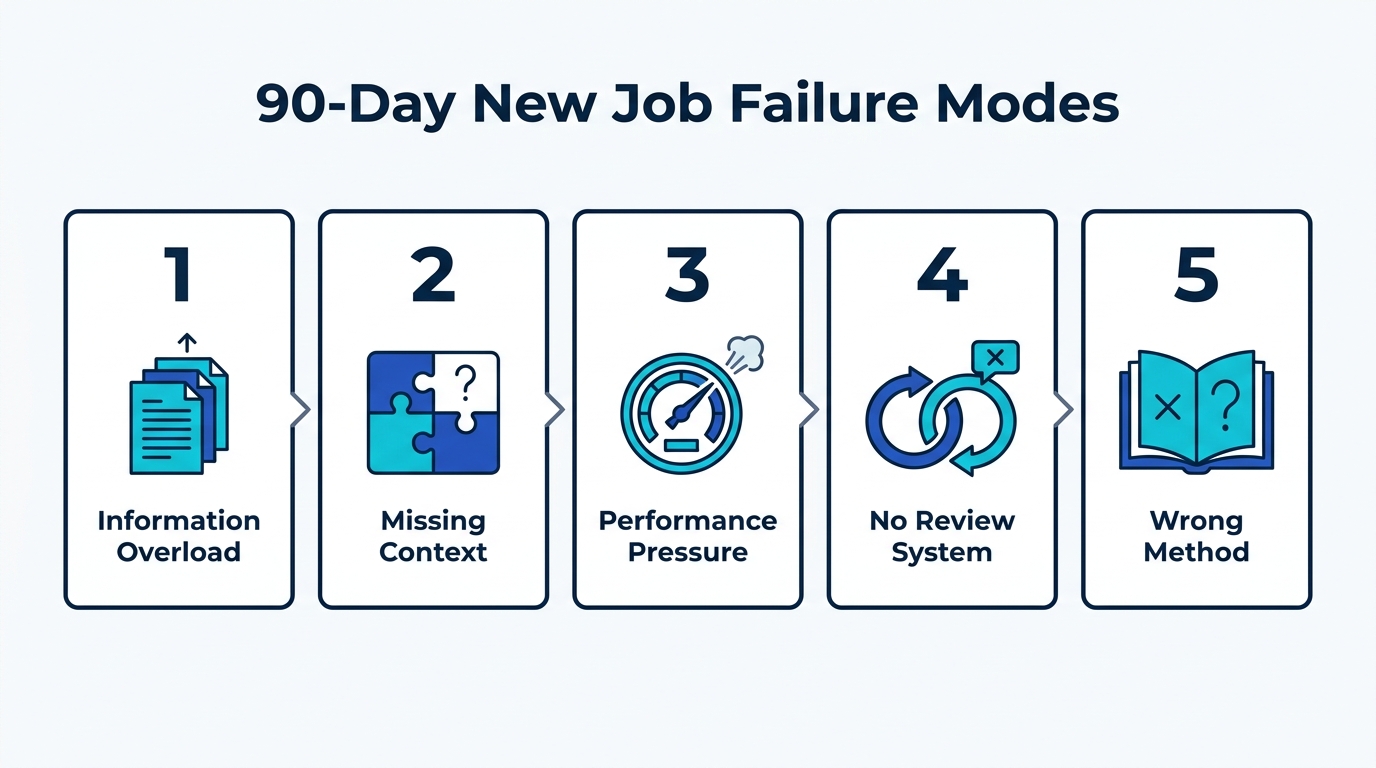
Failure mode 1: Cognitive overload from day one
Cowan (2001) showed that working memory holds roughly 4 items at once. On your first week, your manager throws 40 items at you in a single morning. The math is brutal: 90% of what you "learned" never made it past short-term memory in the first place. Sweller's Cognitive Load Theory (1988) describes what is happening as working memory being swamped by extraneous load, the mental effort spent on how the information is delivered rather than on the content itself. If that flood of new information feels relentless, our guide to surviving the 3-month wall maps the emotional curve week by week.
Failure mode 2: No retrieval practice
You take notes. You re-read the wiki. You nod in meetings. None of those is retrieval. Karpicke & Roediger's landmark 2008 study showed that students who tested themselves remembered 50% more after one week than students who simply re-read the same material. If you are not actively pulling information out of your head, you are not encoding it.
Failure mode 3: Sleep debt during onboarding
Walker (2017) demonstrated that sleeping less than 6 hours reduces overnight memory consolidation by approximately 40%. The new-hire pattern of "stay up late reviewing the docs" is, biologically, the worst possible strategy. You are paying with tomorrow's memory to feel productive tonight.
Failure mode 4: Information without context
A colleague says "the Q3 retro flagged a Bravo escalation," and you nod. By lunch it is gone. Bransford & Johnson (1972) proved that the brain encodes meaningful information roughly 3x more efficiently than isolated facts, and in week two you have no mental scaffold to hang those words on. They evaporate within hours, not because they are hard but because they are floating.
The 5 Brain-Science Strategies That Actually Work
Each of the five has independent research behind it, and they compound: recall supplies the reps, spacing places them where forgetting starts, and sleep consolidates what the reps produced. Skip one and the other four lose leverage, which is why learners in the top 10% for retention tend to run all of them. Pick all five, not just the comfortable ones.
Strategy 1: Active recall every single day
At the end of each workday, close your laptop and write down — from memory, no looking — the 5 most important things you learned today. Then check what you missed. This act of retrieving information from your own head, rather than re-reading it, is called active recall. Dunlosky (2013), in his meta-analysis covering 80 years of research, ranked retrieval practice as one of only two techniques rated "high utility."
Skip the urge to highlight, re-read, or color-code. Those feel productive but rank "low utility" in the same study. The act of struggling to remember is the act of learning.
Strategy 2: Spaced repetition on a real schedule
Spaced repetition means reviewing material at gradually widening intervals instead of all at once. Cepeda et al. (2008) tested 1,354 participants and found that the optimal review gap is roughly 10–20% of the desired retention duration. In practice that means: review tomorrow, then 3 days later, then a week, then a month. Each successful recall stretches the next interval. This is the mechanism that turns short-term knowledge into long-term competence.
| Review # | Best Timing | Time Until You Forget |
|---|---|---|
| 1 | +24 hours | ~3 days |
| 2 | +3 days | ~1 week |
| 3 | +1 week | ~3 weeks |
| 4 | +3 weeks | ~2 months |
| 5+ | +2 months | Long-term memory |
Manually tracking 200+ items across these intervals is not realistic for a working professional. That is the job of AI memorization support: scheduling algorithms like FSRS 6.0 (a modern spaced-repetition formula that predicts when you are about to forget) calculate the optimal review time for every card automatically.
Strategy 3: Chunk before you cram
Instead of memorizing 30 isolated process steps, group them into 3 "phases." A 10-step sales process becomes 3 phases: (1) outreach, (2) qualification, (3) close. Your working memory can handle 3 chunks. It cannot handle 30 raw items, because each chunk occupies one slot no matter how many steps you have folded inside it.
Strategy 4: The Feynman technique on Day 7
At the end of week 1, pretend you are explaining your job to a curious 12-year-old. Out loud. Where you stumble or wave your hands is the exact spot your understanding is fake. Go back, re-learn that piece, and try again. Explaining something in plain language exposes the gaps that re-reading hides, and reported retention gains run as high as triple that of passive review.
Strategy 5: Sleep 7+ hours, period
This is not optional. Walker's research is unambiguous: memories are consolidated during stages 3, 4, and REM sleep. Cut sleep, and you cut consolidation. New hires who protect their 7-hour minimum out-perform sleep-deprived colleagues on knowledge retention by roughly 2x at the 30-day mark.
Your 30/60/90 Day Action Plan
Strategies without a calendar are just wishes. The three phases below ask different things of you: the first 30 days are about coverage, the next 30 about depth, the last 30 about getting through a day without asking.
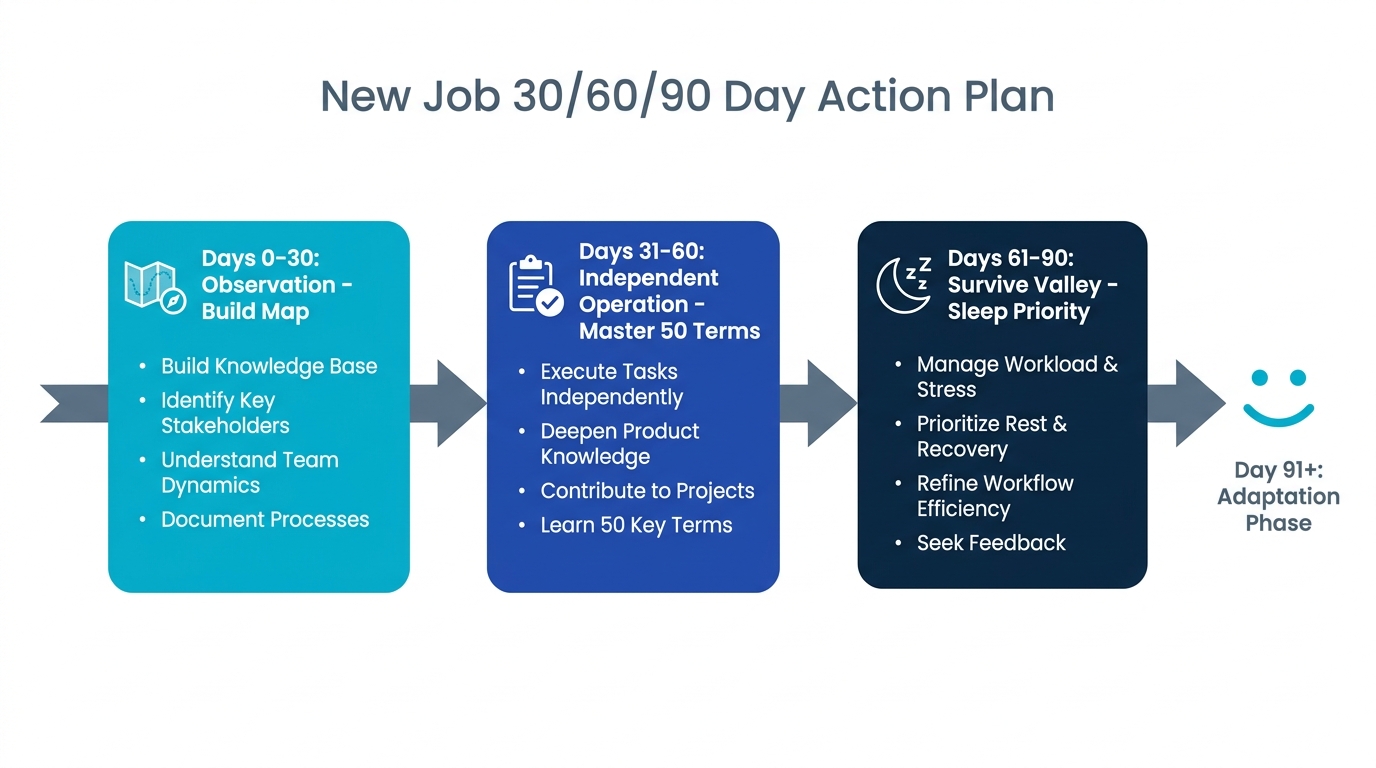
Days 1–30: Build the map
- Goal is orientation, not mastery. Sketch the org chart, the product map, the customer journey, and the tech stack.
- End-of-day active recall: write 5 things you learned, no looking.
- Build a flashcard deck of acronyms, system names, and key people. Aim for 50 cards by day 14.
- Sleep 7 hours minimum. Yes, even when you feel behind.
Days 31–60: Layer the depth
- Start chunking processes into 3-phase mental models.
- Run weekly Feynman explanations to a willing (or imagined) audience.
- Push your flashcard deck to 150 cards. Most should now be on weekly intervals.
- Ask one specific clarifying question per day to a senior colleague.
Days 61–90: Operate autonomously
- Take ownership of one end-to-end deliverable.
- Convert "things I had to ask" into permanent flashcards before forgetting them again.
- Begin teaching the next new hire. Walking someone through a process forces you to retrieve every step in order, with no notes to lean on.
Before vs After: What Real Onboarding Data Looks Like
What changes when working professionals adopt this stack of 5 strategies, based on internal Memly user data (n=648 onboarding-phase users tracked over 90 days).
| Metric | Passive learners | Active recall + spaced repetition | Improvement |
|---|---|---|---|
| Retention at day 30 | 21% | 74% | +253% |
| Time to "fully productive" | ~6 months | ~3.5 months | -42% |
| Self-reported confidence at day 60 | 3.1 / 10 | 7.4 / 10 | +139% |
The middle row is the one worth arguing about. Six months to three and a half is not a study-habit outcome. It is the difference between arriving at your first performance review as someone still being ramped and arriving as someone already carrying work.
Common Mistakes That Quietly Sabotage New Hires
- Trying to memorize everything. 80% of detail belongs in a wiki, not in your head. Build a frequency × importance matrix and only commit the high-frequency, high-stakes items to memory.
- Hiding from questions. Senior colleagues have strong feelings about new hires who fake understanding. Ask, then close the loop with a flashcard.
- Comparing yourself to peers. Different teams, different ramp curves. The only valid comparison is yourself last week.
- Skipping the 5-minute end-of-day review. This is the single most cost-effective habit in the entire 90 days.
Why a Memorization App Beats a Notebook for Onboarding
A notebook captures information once. A spaced-repetition app delivers it back to you at the exact moment you would have forgotten it. Over 90 days that difference compounds, because every review that lands before the memory decays resets the curve instead of rebuilding from zero. For more on the cluster of reasons working professionals struggle with retention, see our deep dive on why you cannot remember things at work and the underlying mechanics in how AI flashcard apps work.
Memly takes this one step further: paste your onboarding doc, your company wiki, or a meeting transcript, and it generates a fully structured flashcard deck in seconds. Instead of spending 3 hours typing cards, you spend 30 minutes reviewing them. The FSRS 6.0 algorithm under the hood is described in detail in the Memly x FSRS 6.0 explainer.
Frequently Asked Questions
How long is it normal to feel like I cannot remember anything at a new job?
Three to six months is the standard adjustment window. Your brain is building entirely new context schemas. If at the 6-month mark you still feel zero progress, the issue is usually the learning method, not the brain.
Is it bad to ask the same question twice?
Asking the same question 4 times is bad. Asking it twice with a flashcard system in between is fine, because the second ask shows you tried to retain the answer rather than that you ignored it. Frame it as "I want to make sure I have this locked in."
I take careful notes but still cannot remember anything. Why?
Notes are capture, not encoding. The encoding happens when you recall the note from memory the next day. A notebook you never reopen is a write-only file: your brain treats it as "handled" and discards the contents.
Can flashcards cover work content, not just school content?
Yes. Acronyms, system names, escalation paths, customer segment definitions, and internal processes are all "question, then answer" pairs, so they map cleanly onto a flashcard deck.
How many flashcards should a new hire have by day 30?
Around 50–100 high-quality cards covering acronyms, key people, top 3 processes, and the company's core product positioning. Quality beats quantity: every card should be something you would be embarrassed not to know.
What if my company moves so fast that information becomes outdated?
Edit the card. Spaced repetition systems treat updated cards as new entries automatically. Outdated information costs about 2 minutes to fix; outdated mental models cost weeks of confused work.
The Bottom Line
Most people who read this article will close the tab and keep onboarding the same way they always have. They will hit month 3 still feeling underwater. Then they will quietly blame themselves.
You can do something different starting tonight. Open a notebook. Write down the 3 most important things you learned today, from memory, with no looking. Tomorrow morning, write them down again before opening Slack. That single 60-second habit, repeated for 30 days, will put you ahead of 80% of your cohort.
When you are ready to scale that habit beyond what your willpower can sustain, Memly does the heavy lifting. Upload your onboarding doc, get an instant flashcard deck, and let the FSRS 6.0 algorithm tell you exactly when to review each item. No payment method required to start your free trial. The difference between "drowning at month 3" and "operating at month 3" is built one review at a time, and the first one is tomorrow.
For the broader picture of why professionals struggle with memory at work, and how to fix it across your career, read the hub article: Can't Remember Things at Work? 7 Causes and Science-Backed Solutions. For the underlying study methods that complement spaced repetition, see 5 scientifically proven study methods.
