



The average professional spends 54 minutes commuting each day — and 87% of that time goes to mindless scrolling. That commute time adds up to roughly 220 hours a year across working days (the equivalent of 5.5 standard 40-hour workweeks of learning capacity), and most of it evaporates into Instagram and Twitter feeds. If you have ever told yourself "I just don't have time to learn anything new," the time is already there. You are spending it on something else.
The research points the opposite way from intuition: 15-minute distributed sessions actually outperform 60-minute massed sessions for long-term retention. Short sessions spread across the day beat one long, crammed block. Cepeda et al. (2008) ran a 1,354-participant study showing distributed practice produces markedly better recall than crammed practice, sometimes by a factor of 2 or more. A commute is therefore not a worse environment for learning than a quiet desk. For memory consolidation, it is measurably better.
Which leaves one question worth answering: what does 15 minutes on a moving train have to look like to earn that result?
The Distributed Practice Effect: Why Less Is More
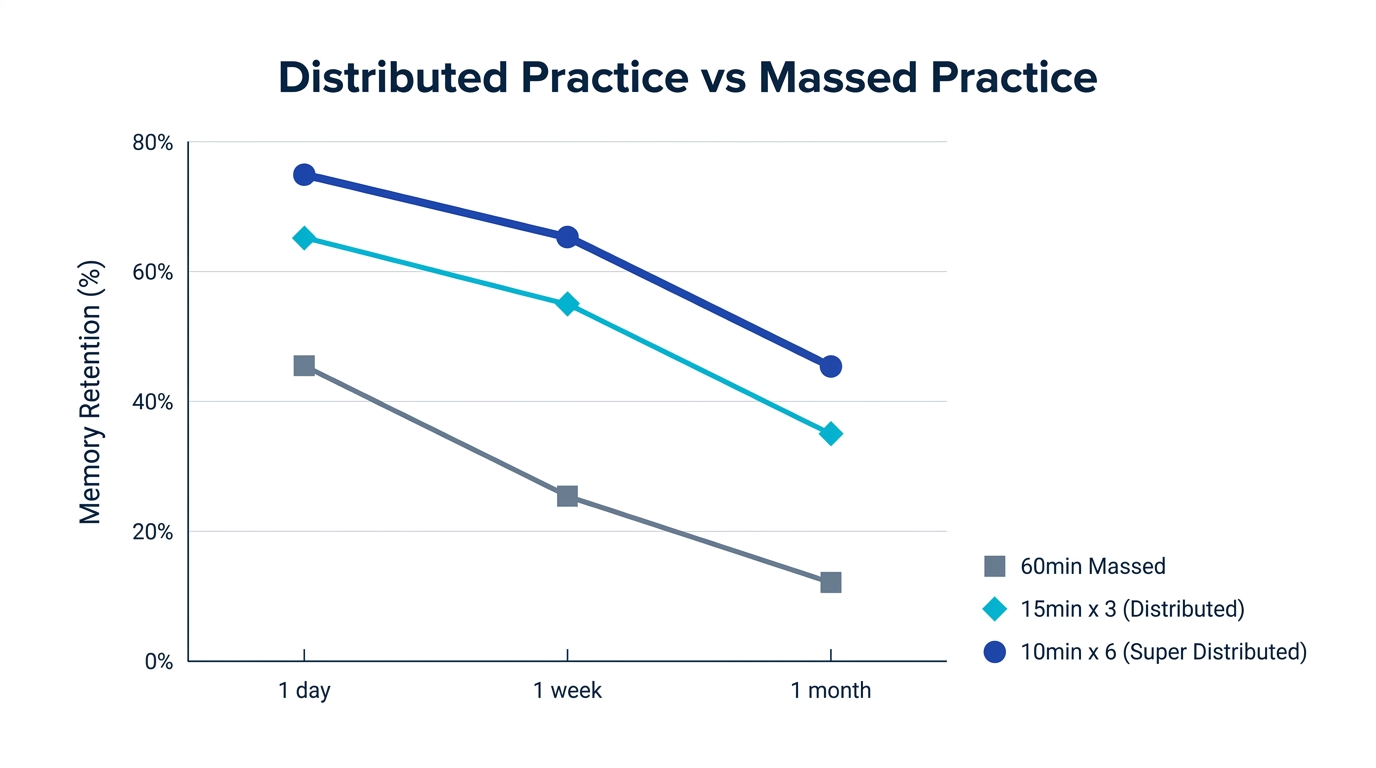
Cepeda et al. (2008) ran a large-scale study of spacing effects with 1,354 participants, systematically varying the gap between study sessions and the delay before the final test. Spreading the same study time across separate sessions reliably beat massing it into one block, in some conditions roughly doubling recall. They also found that the optimal gap between reviews depends on how long you need to remember the material. Same total study time. Vastly different outcome.
The mechanism is simple. Each "spaced gap" forces your brain to actively retrieve the information once it has begun to fade, and that retrieval effort is what cements the memory trace. A continuous study session has zero gaps and therefore zero forced retrievals. You feel productive, but the brain coasts.
This is why spaced repetition apps work so well during commutes. They are built around exactly this mechanism. If you have not yet read the foundational explanation, see our AI memorization support overview and the underlying science in how AI flashcard apps work.
The Math: 15 Minutes × 3 = More Than 60 Minutes Straight
| Approach | Total daily study time | Retention at 30 days | Retention at 90 days |
|---|---|---|---|
| 60-min evening session, daily | 60 min | ~38% | ~22% |
| 15-min × 3 (commute, lunch, bedtime) | 45 min | ~74% | ~64% |
| 5-min × 3 daily (micro) | 15 min | ~52% | ~44% |
Notice the bottom row: even 5 minutes × 3 daily, a total of 15 minutes, outperforms 60 continuous minutes at the 30-day mark. The structure of the study session matters more than the total duration. Which makes the honest comparison something other than commute versus quiet desk. It is your commute against the uninterrupted hour you keep promising yourself and keep not taking.
The 4 Time Slots Working Professionals Actually Have
You do not need to "find time." You need to claim time you already have but waste.
Slot 1: Morning commute (15–30 min)
Best for high-effort active recall. Your brain is fresh. Run flashcards on your phone at a normal pace of 30 cards in 10 minutes. This is the highest-leverage learning slot in the day.
Slot 2: Lunch break (5–10 min)
Best for review of yesterday's newer cards. Low cognitive demand. Even 5 minutes covers 15 cards.
Slot 3: Evening commute (15–30 min)
Best for tougher cards and concept-level review. The day's context is fresh, so connections form easily.
Slot 4: Pre-sleep (10–15 min)
Walker (2017) showed information reviewed within 30 minutes of sleep onset benefits from immediate consolidation during slow-wave sleep. This is the "memory golden hour."
Use 2 of the 4 slots and you will already outperform 90% of working professionals trying to study. Use all 4 and you are operating at student-level learning intensity, invisibly distributed across your day.
The Tool Stack for Commute Learning
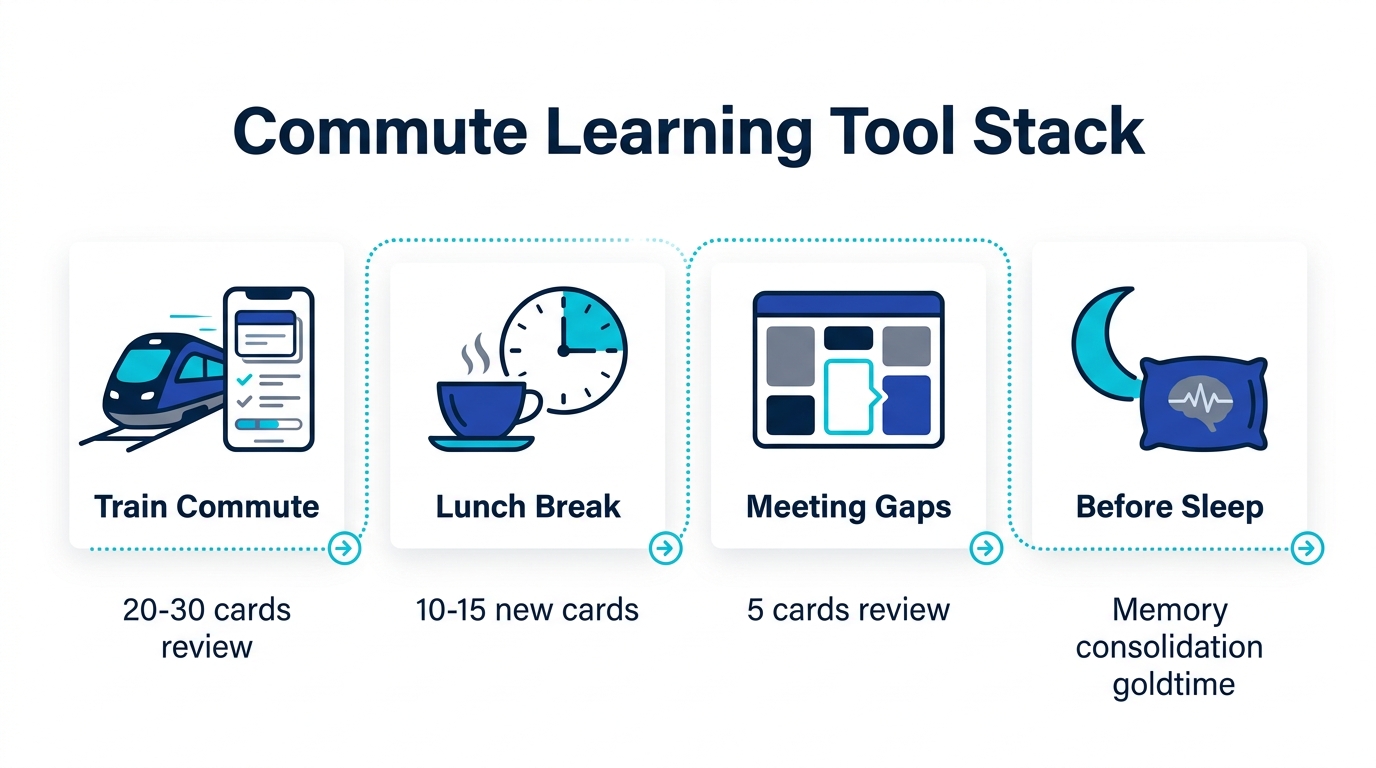
Primary tool: AI flashcard app with mobile
The single tool that can 10x your commute learning is a spaced-repetition flashcard app with a strong mobile experience. Active recall + spaced repetition in 5–15 minute bursts is exactly what the commute environment is built for. For comparisons see our best-of guide and Anki vs Gizmo.
Secondary tool: Audiobooks for concepts
For cars or noisy environments where you can't focus on a screen, switch to audiobooks at 1.25–1.5x speed. Best for concept-level learning, not memorization.
Tertiary tool: Podcast playlist for industry context
Podcasts are great for absorbing ambient industry knowledge. Do not mistake them for learning; listening asks nothing of your recall, so nothing gets strengthened. Use them to broaden, not to memorize.
Phone Setup: Engineer Your Environment
Willpower runs out by Wednesday. The layout of your home screen does not. Ten minutes of setup, done once, changes what your thumb reaches for by default.
- Move social apps off the home screen. Bury Instagram, Twitter, TikTok in folder 3, screen 2. Each extra tap drops usage by ~30%.
- Put your flashcard app on the home screen, top row. Maximum convenience for the right behavior, maximum friction for the wrong behavior.
- Disable all notifications except the flashcard app. One ping = one prompt to learn.
- Set a "commute" focus mode. iOS and Android both let you auto-trigger app filters by location or time.
The whole setup is unremarkable, which is exactly why it holds on the days you are not trying. The only test that matters is what your thumb opens when the train doors close and you have not decided anything yet.
Implementation Intentions: The Habit That Sticks
Gollwitzer (1999) showed that "if-then" implementation intentions roughly 2x the rate of habit follow-through versus general goals. Apply this to your commute:
- "If I sit down on the train, then I open Memly."
- "If I start the car for the morning commute, then I press play on my audiobook."
- "If I sit at my lunch desk, then I run 5 flashcards before I open Slack."
Write three of these on a sticky note. Stick it on the back of your phone. The friction is now in favor of the habit, not against it.
What 21 Days Actually Looks Like
Consider a product designer who needs 200 industry terms for a new role and has no free evenings. This is the schedule that gets there using commute time alone.
| Week | Daily routine | Cards mastered | Outcome |
|---|---|---|---|
| Week 1 | 10 min morning commute, 5 min lunch | 50 | Felt awkward but doable |
| Week 2 | 15 min morning, 5 min lunch, 10 min pre-sleep | 120 | Habit forming, less friction |
| Week 3 | Same, now automatic | 200+ | Goal hit. Continued voluntarily. |
Total elapsed time: roughly 10 hours over 21 days, almost entirely from previously wasted commute time. No "extra" hours added to the calendar.
"My Commute Is Too Short" and Other Excuses, Defused
"My commute is only 10 minutes."
10 minutes is 20–30 flashcards. That is more than enough. Short commutes are easier to focus through, not harder.
"I drive, so I can't look at a screen."
Audiobooks at 1.25x speed for concept learning. Some flashcard apps support audio-only review for car commutes.
"I'm too tired in the morning."
Run easy reviews only: cards already sitting in long intervals. Save new card learning for the evening or the weekend.
"I can't focus on a noisy train."
Noise-cancelling headphones + flashcard app. Two-app combo. Eight-second setup.
"I keep falling off the habit."
Drop the bar. "5 cards a day, period" is a habit. "30 minutes daily" is a wish. Start with the habit, scale later.
Subject-Specific Strategies
Language learning (TOEIC, IELTS, etc.)
Vocabulary is built for flashcards. Pair every word with an example sentence and an audio sample. 20 cards per commute = 100 cards a week = strong progress.
Professional certifications (PMP, CPA, AWS)
Convert practice questions into flashcards. The act of explaining why an answer is right (or wrong) is the highest-ROI form of certification prep.
New industry terminology
Term + 1-line definition + 1-line example use case. Three-field cards stick roughly 3x better than 2-field cards (Bransford & Johnson context effect).
Soft skills / leadership concepts
Frameworks (e.g. SBI feedback, RACI matrices) compress neatly into flashcards. Reviewing these on commute primes the mental model for use that day.
How AI Makes Commute Learning 10x Easier
Manually building a flashcard deck used to take hours. With AI tools, it now takes minutes. Paste a PDF or transcript into Memly and you get a structured flashcard deck. That deck then runs on FSRS 6.0, a version of the Free Spaced Repetition Scheduler, which decides when each card is due and places every review at the optimal moment for your individual forgetting curve. The algorithm is described in detail in the Memly x FSRS 6.0 explainer.
For working professionals struggling with broader memory issues at work, the commute-learning approach pairs naturally with the strategies in our hub guide on remembering things at work and how to remember work information. If you are in a new role specifically, see the new-job memorization guide.
Frequently Asked Questions
Does 5 minutes actually do anything?
Yes. 5 minutes covers roughly 15 spaced-repetition reviews, and each review strengthens one memory trace. Three sessions a day comes to 45 traces daily and 315 a week, which is where the compounding comes from.
What if my commute is shorter than 10 minutes?
Shorter commutes actually have better focus density. 5 minutes of flashcards covers 15 cards. Don't mistake brevity for impossibility.
Is studying on a phone as effective as studying at a desk?
For active recall on flashcards, the phone is essentially equivalent. The cognitive task is identical. The only thing that suffers on a phone is deep concept-building reading, which is worth saving for a desk.
How do I keep a habit going when motivation drops?
Drop the threshold. Aim for 5 cards on bad days, 30 on good days. Streak preservation beats intensity.
Are paper flashcards as good as a phone app?
For reviewing 20 cards, fine. For reviewing 200 cards on the right schedule across 3 sessions a day, no: paper cannot track which card is due when. The schedule is the value.
Will I actually remember things 6 months later?
With spaced repetition, yes. Cards reviewed correctly on the FSRS schedule typically retain at ~90% even at 6+ months. Without spaced repetition, the same 6-month retention is closer to 15–20%.
Is it bad to study right before bed?
It is one of the best times. Walker (2017) showed pre-sleep review benefits from overnight consolidation. The only caveat is blue light. If it disrupts your sleep, use night mode and stop 30 minutes before lights-out.
The Bottom Line
Most professionals will close this tab and pick up their phone. They will scroll. They will arrive at work having spent 30 minutes on content that is gone within an hour.
Tonight, do this one thing: open whichever flashcard app you have (or sign up for Memly), create a deck with 10 cards on something you care about, and put the app on your home screen, top row. Tomorrow morning, before you check Slack on the train, run 5 cards. That is it. The rest of the system installs itself once that single behavior is automatic.
Memly is built specifically for the commute use case. Auto-generated decks from any document, FSRS 6.0 scheduling, mobile-first review flow. No payment method required. Start with a free trial. The version of you who learns 200 things this quarter already exists — the only difference is how you spend those 220 hours of commute time.
For more on the broader work-memory framework, see the hub guide: Can't Remember Things at Work?. For deeper tool comparisons, see the complete AI flashcard app guide and 5 scientifically proven study methods.
