


When Google's NotebookLM turned documents into a two-host conversation with its Audio Overview, it stunned a lot of people. Your own material, flowing into your ears like a radio show. Plenty of learners immediately wondered whether they could use that for studying. But the moment you try to use it for the daily review of what you're memorizing, you hit a wall. You have to upload your material every time, regenerate the episode, and even then the episode has no idea which cards you happen to be forgetting today.
Memly's Review Radio is built for that job specifically: daily review, as opposed to first-time understanding. Which makes these two less like competitors than like a division of labor.
In short: NotebookLM's Audio Overview is excellent for understanding a document, but not for daily review, because it cannot track which cards you are forgetting today. A study podcast built from your own forgetting curve, refreshed daily and non-repeating, is the retention engine. Understand with NotebookLM; retain with Review Radio.
Why NotebookLM's Audio Overview resonated
The appeal was obvious. A document you couldn't be bothered to read becomes a natural two-host conversation, so you can listen to it like a podcast while doing something else. Even dense, technical material goes down more easily in dialogue form, because a question from one host supplies the framing your own reading would have had to build. The experience of hearing your own source material turned into a show was genuinely new.
Review Radio shares that exact format: a two-host conversation. The pleasant-to-the-ear, easier-to-grasp quality of dialogue is common to both. Where they diverge is in what serves as the source, and what the goal is.
Three things it lacks for "daily review"
So why not simply regenerate the episode each morning with today's material? That is the obvious workaround, and it breaks for three separate reasons, none of which has anything to do with audio quality.
1. The source is "your documents," not "your review queue"
NotebookLM's episode summarizes and explains the documents you uploaded. That's ideal for understanding something for the first time, but it does not select the cards you happen to be forgetting today. What review actually needs is not a summary of the whole document, but pinpointing the specific memories that are slipping and recovering them.
2. Refreshing it takes manual work every single day
Review works only if you do it daily. But to build a fresh review episode in NotebookLM each day, you have to prepare the material and regenerate every single time. Nothing prepares today's portion for you automatically, so the habit survives only as long as your willingness to repeat that setup.
3. It isn't optimized by the forgetting curve
This is the biggest difference. NotebookLM does not hold a model of your memory state: which cards you have missed, how many times, and when each one is likely to fade. So it can't do the optimization at the heart of spaced repetition: prioritize what you're about to forget, and skip what you already know. For why that optimization is what decides retention, see our analysis of whether audio learning works.
Review Radio: your forgetting curve, turned into a daily episode
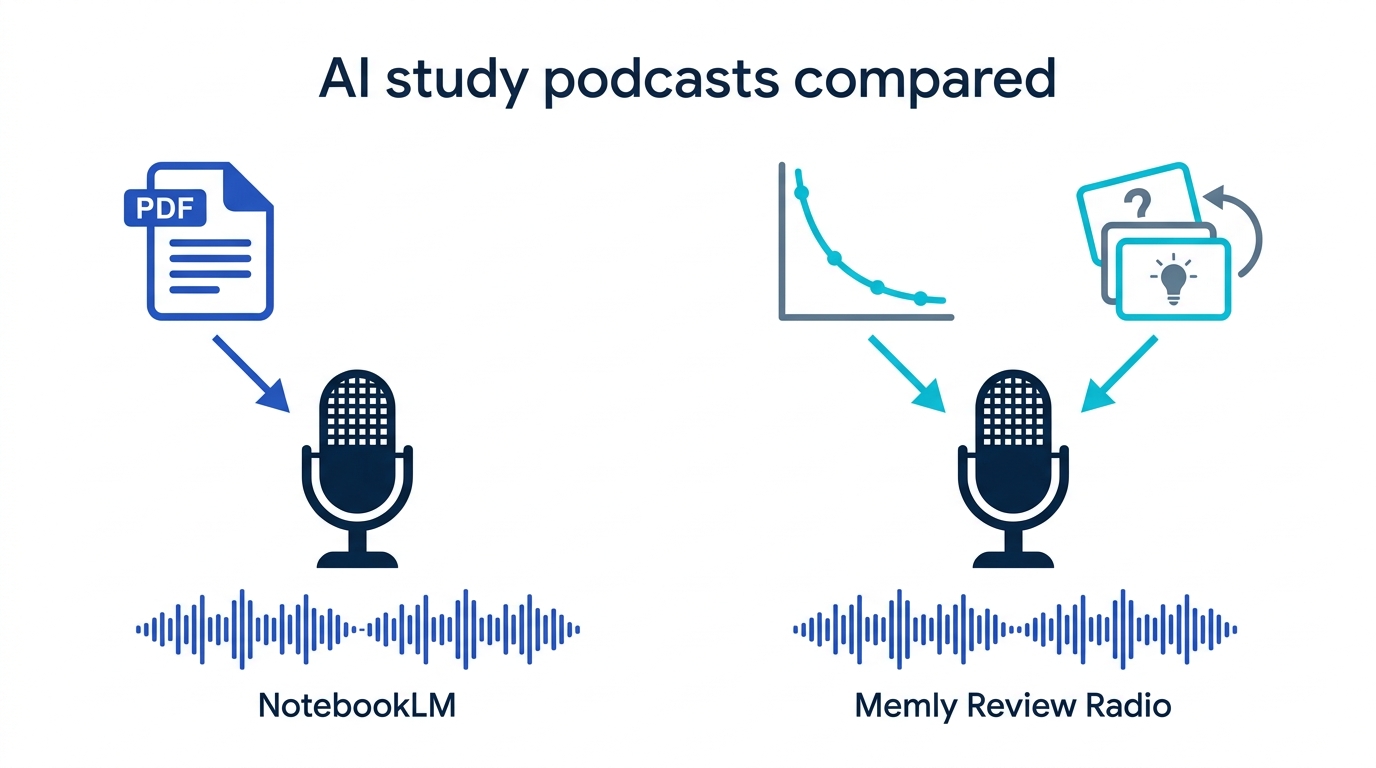
Memly's Review Radio is an audio feature purpose-built for exactly this "daily review" job. The source is your flashcards; the goal is retention. The episode is assembled by AI from only the cards you're about to forget that day.
| Aspect | NotebookLM Audio Overview | Memly Review Radio |
|---|---|---|
| Source material | Documents you upload | Your flashcards (your review queue) |
| Main goal | Understand new content | Retain what you've learned |
| Question optimization | None (explains the whole document) | Prioritizes about-to-forget, overdue, and missed cards |
| Daily refresh | Upload and regenerate each time | Today's review turned into an episode automatically |
| Repetition handling | Same document, same episode | Avoids recently used cards; changes each time |
| Recall pauses | Explanation-focused | A pause to recall before the answer |
| Format | Two-host conversation | Two-host conversation |
The daily-refresh row is the one that decides whether any of this becomes a habit. An episode you have to regenerate is a chore you will do maybe four times. An episode already waiting when you unlock your phone is one you listen to on the walk to the station.
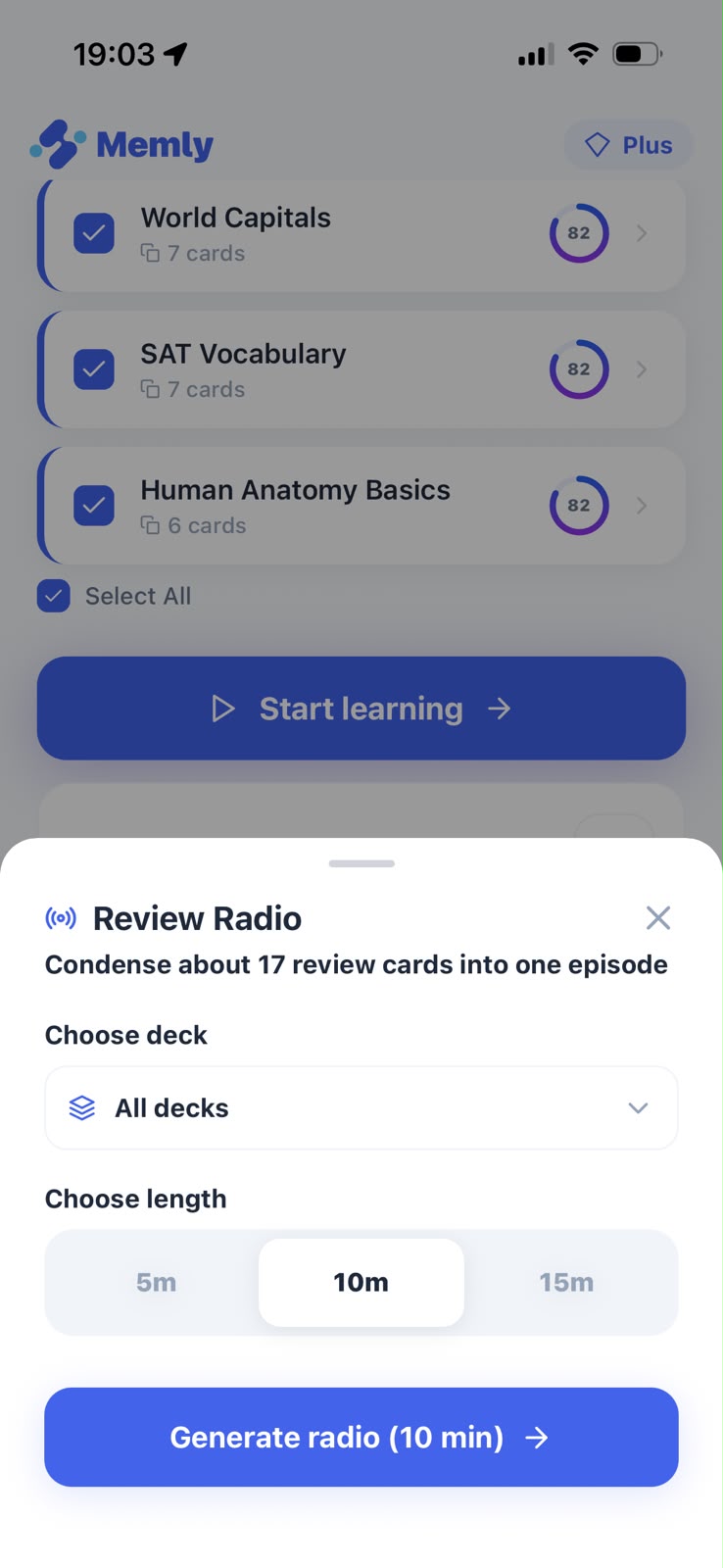
The controls are tuned for review, too. Pick a deck and a length (5, 10, or 15 minutes), hit generate, and you get an episode that spans multiple subjects, woven into one conversation.
Which should you use? Understand with NotebookLM, retain with Review Radio
These two aren't in opposition. They handle different phases of learning.
- You want to understand new material the first time: to chew through a paper, a textbook, or internal docs by ear, NotebookLM's Audio Overview is the right fit.
- You want to keep from forgetting what you've learned: to run daily review and recover what's slipping, Review Radio is the right fit.
The ideal flow: understand the content (with NotebookLM or anything else), distill it into flashcards, and then hand the long-term retention to Review Radio. The card creation can be handled by AI too — see how AI flashcard apps work and the broader complete AI flashcard app guide.
Frequently asked questions
Can't I just make review episodes in NotebookLM?
You can make explanation episodes from your documents. But it doesn't have the three review-specific optimizations: selecting only the cards you are forgetting today, preparing today's portion automatically, and avoiding repetition. If daily retention is the goal, Review Radio is designed for that role.
Does Review Radio also use two hosts, like NotebookLM?
Yes. Review Radio is also a two-host conversation, recorded in native voices (English, Japanese, Korean, and Chinese). The difference is not the format. It is the source material and the question optimization.
Is there any point in using both?
Yes. Use NotebookLM to understand new content and Review Radio to retain what you've learned, and you can run the whole arc from understanding to retention primarily through audio.
What is the source for each one?
NotebookLM draws on the documents you upload. Review Radio draws on your flashcards, specifically the cards in your review queue that are due, and builds the episode from only the facts on those cards.
The bottom line: turn the format you love into a review engine
If you loved NotebookLM's Audio Overview, the pleasure was in one specific experience: your own material becoming a two-host conversation. Review Radio takes that same pleasure and points it entirely at the daily retention of what you memorize. Instead of explaining a document, it takes your forgetting curve as the source and prepares a different episode for you automatically, every day.
Most people will think "that sounds handy" and stop there. Only the ones who actually try hearing their own review become a show on tomorrow's commute will feel the difference. Memly is an AI flashcard app: it generates flashcards automatically from PDFs and text, and connects all the way through to Review Radio. No credit card required, and it's free to start. For the full picture of AI-powered memorization, see what AI-powered memorization is, and for the hands-free angle, see how Review Radio turns your due cards into a podcast.
