



You started a course in January. Three weeks in, the streak broke. By February, you stopped opening the app entirely. Sound familiar? You are not the exception. You are the statistical norm. A 2024 LinkedIn Learning report found that 68% of working professionals abandon a self-study program within 3 months of starting it. The cause is almost never willpower. It is seven structural failures in how the modern professional brain interacts with self-directed learning, and each has a measurable, behavior-science-backed fix.
Seven is the awkward number here. Any one of them alone is survivable, and they rarely arrive alone. Lally et al. (2010) on habit formation, Bandura (1977) on self-efficacy, and Cepeda et al. (2008) on distributed practice each describe a different one of the seven, which is why the repair has to be matched to the failure rather than applied in bulk.
The 7 Real Reasons Working Professionals Cannot Stick to Studying
Most professionals diagnose themselves as "lazy" or "undisciplined." This is the worst possible starting point for behavior change because it offers nothing actionable. The actual causes are nearly all structural: they live in the brain's reward system, in your environment, or in the design of your learning routine.
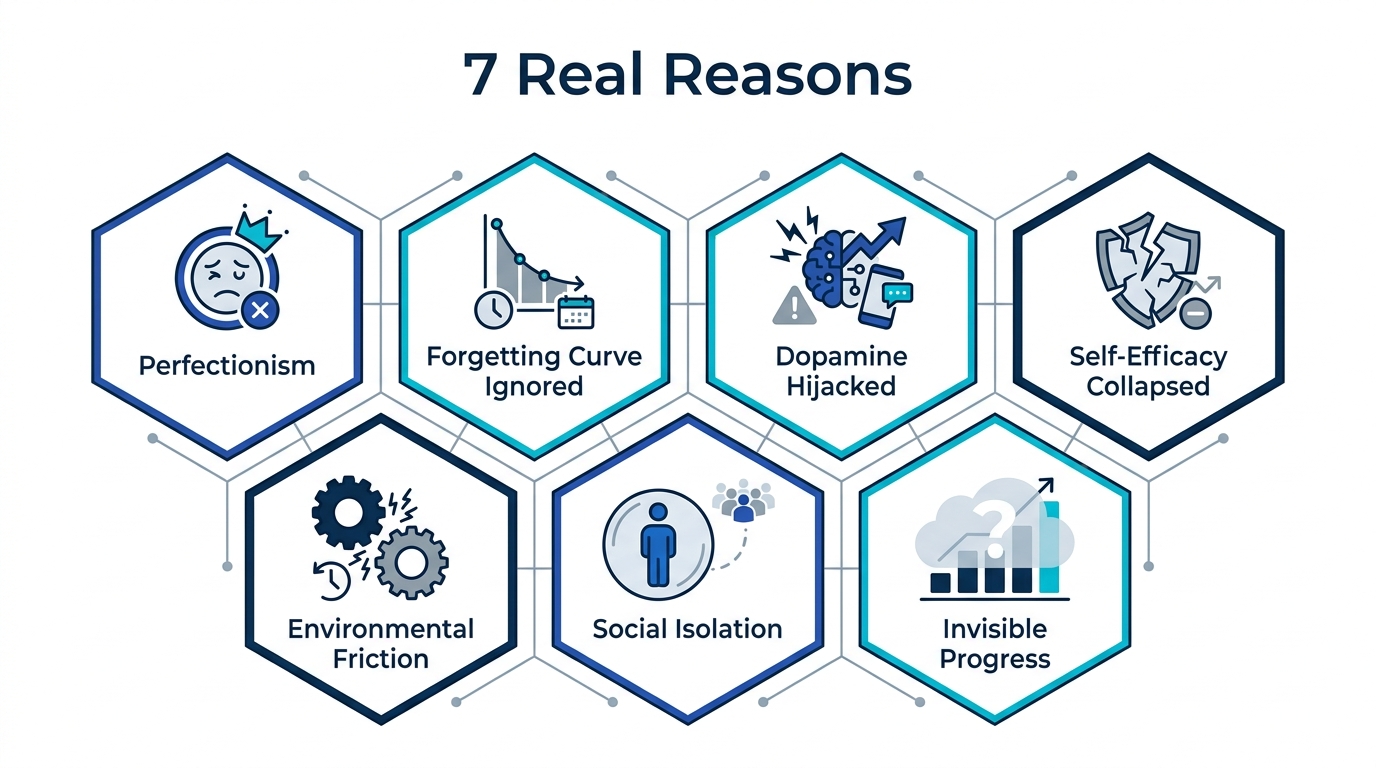
Cause 1: Perfectionism Creates the No-Start Loop
"I'm too tired today. I'll do it properly tomorrow when I can focus." This is the signature thought of professionals who cannot sustain study. Sirois & Pychyl (2013) describe this kind of procrastination as short-term mood repair, meaning you delay the task to escape the discomfort it triggers. Pursuing quality, you achieve zero quantity. The deeper neuroscience and the 80% Initiation Method that breaks this loop are in The Perfectionism Learning Trap and the 80% Initiation Method.
Cause 2: Ignoring the Forgetting Curve
Ebbinghaus showed humans forget about 70% of new information within 24 hours. Most professionals stop reviewing the moment they "feel like they've learned it." Two weeks later, they sit down, find they remember nothing, and conclude "studying does not work for me." It works fine. They simply skipped the spacing protocol that all memory science requires. The optimal review timing science and the FSRS vs. fixed-interval comparison are detailed in When to Review What You Learned.
Cause 3: Dopamine System Hijacked by Modern Stimuli
You sit down with fifteen minutes free, and one term on a card feels unbearably slow. Scrolling for the same fifteen minutes does not. Volkow et al. (2010) demonstrated that brains adapted to high-frequency social media and gaming reward loops have a reduced dopamine response to low-stimulus tasks such as memorizing one term or reading one paragraph. Studying does not feel boring because it is. It feels boring because your reward system has been temporarily recalibrated by other inputs.
Cause 4: Self-Efficacy Collapse After a Past Failure
The third time you start the same course, something has changed, and it is not the material. Bandura (1977) called self-efficacy the brain's prediction of "I can do this." After one failed attempt, a residual prediction of failure attaches to the next try, suppressing initiation rates by 30 to 50%. The mechanism is neurological, not moral.
Cause 5: Friction Cost of Your Learning Environment
Fogg (2019) showed behavior follows the formula B = MAT (Motivation × Ability × Trigger). Friction (opening the textbook, finding your notes, booting your laptop) drives the Ability score down. People who actually sustain study habits have engineered environments where they can begin studying within 10 seconds. A phone in your hand, the app already at the top of the home screen, no decisions required. The seven concrete designs that compress friction below 10 seconds are detailed in Seven Designs to Remove Environmental Friction from Learning.
Cause 6: Social Isolation Removes the Continuation Reward
Nobody notices if you stop. That is the whole difference between a class and a self-study plan, and it turns out to weigh more than it sounds. Deci & Ryan's (2000) Self-Determination Theory identifies relatedness as one of three pillars of intrinsic motivation. Without it, retention rates drop structurally. Learners who last put the accountability somewhere outside themselves: a public commitment, a study community, a sentence said out loud to family.
Cause 7: Invisible Progress = No Reward Signal
Locke & Latham (2002) showed that without visible progress, the brain receives no reward signal, and without that signal dopamine release stays flat. Paper textbooks fail this test badly, because nothing about a stack of pages shows you how far you have come. Streaks, completion percentages, review calendars, and card counts are not gamification gimmicks; they are the brain's required input to keep going.
The Forgetting Curve You Cannot Negotiate With
Of all 7 causes, the forgetting curve is the one that breaks the most well-intentioned learners. Ebbinghaus (1885) ran the foundational memory experiment and produced these numbers, replicated in dozens of subsequent studies.
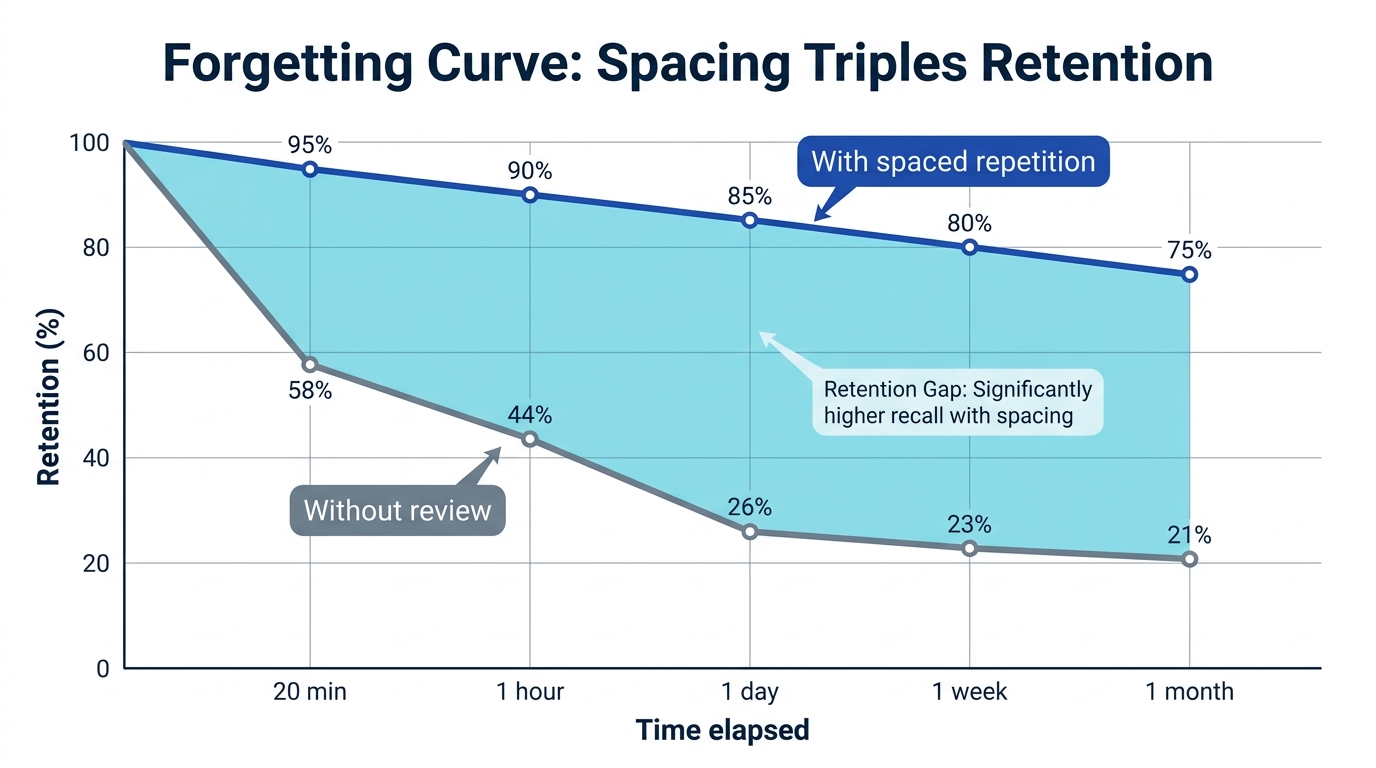
| Time elapsed | Retention without review | Retention with spaced review | Difference |
|---|---|---|---|
| 20 minutes | 58% | ~95% | +37% |
| 1 hour | 44% | ~90% | +46% |
| 1 day | 26% | ~85% | +59% |
| 1 week | 23% | ~80% | +57% |
| 1 month | 21% | ~75% | +54% |
The implication: building a spaced review schedule into your routine moves retention from ~21% to ~75%, more than tripling the value of every minute you study. The "I forgot everything in 3 weeks" experience is largely a function of skipped spacing, not a failure of your memory. For implementation tools, see our complete guide to AI flashcard apps.
4 Mechanisms That Successful Long-Term Studiers Actually Use
People who sustain study for years have not out-muscled the problem. They have engineered four specific mechanisms into their lives, derived from Lally et al. (2010) and converging behavior science.
Mechanism 1: Lower the Bar Until the Brain Cannot Refuse
BJ Fogg's Tiny Habits method: shrink the action until the brain has no grounds to argue. "30 minutes of study" becomes "review one flashcard." Fogg's self-experiment data shows initiation rates jump from ~25% to 78% when actions become micro-sized.
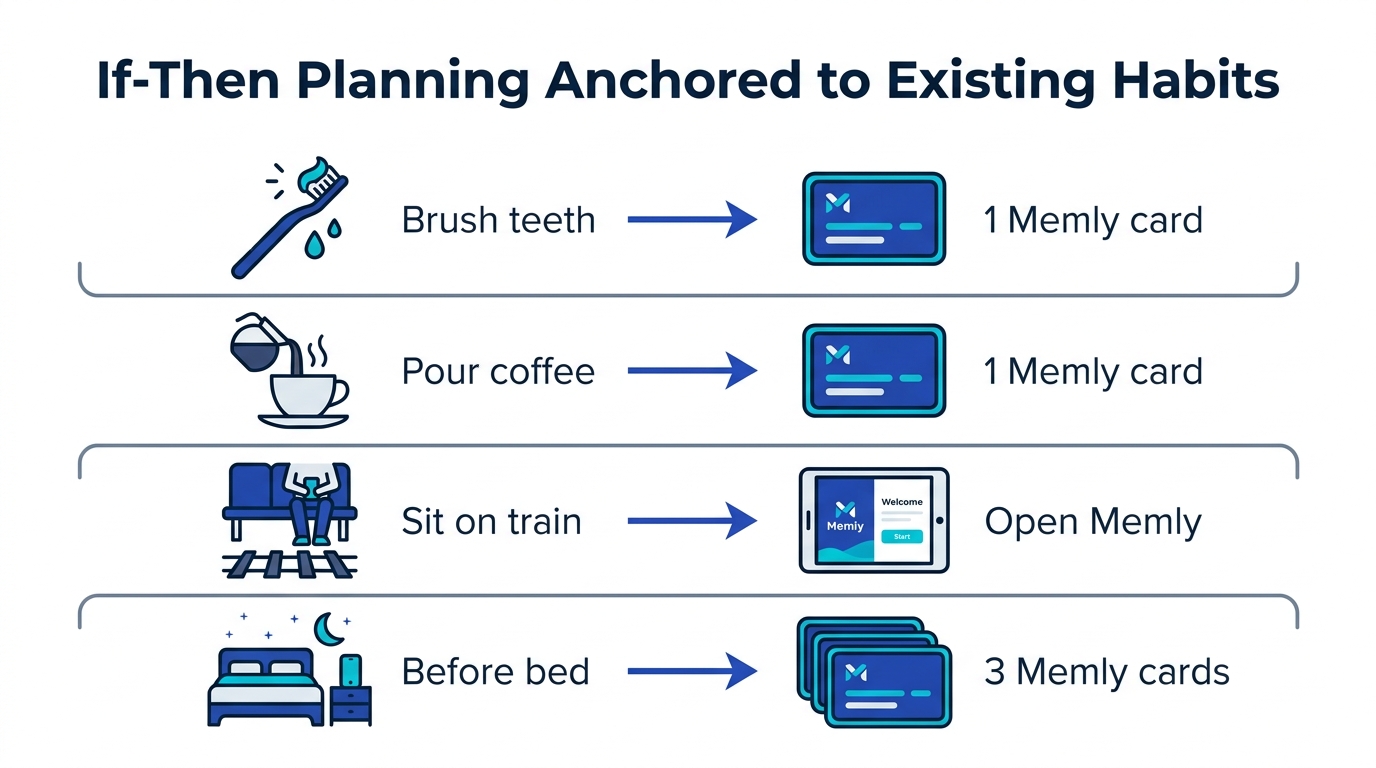
Mechanism 2: Anchor Habit Stacking to an Existing Automatic Behavior
James Clear (Atomic Habits) systematized Habit Stacking: attach the new habit to a behavior you already perform automatically every day. "After I brush my teeth → I review 1 Memly card." "After I sit on the train → I open Memly, not Twitter." The existing habit supplies the willpower; the new habit costs nothing.
Mechanism 3: Make Progress Visible
Invisible progress cannot be argued away with a better mood. It needs a number. Pick one that moves every single day: the streak, the count of cards due, the share of a deck marked mature. Locke & Latham (2002) tie exactly that visible movement to the dopamine release that drives continuation. The day you can see your streak hit 30 is the day quitting feels expensive.
Mechanism 4: Pre-Design the Recovery Path
Everyone breaks the streak eventually. Polivy & Herman (2002) named the "What-the-Hell Effect": after one missed day, people interpret it as total failure and abandon the entire program. The countermeasure is pre-commitment: before you start, decide what you will do after a 1-day miss, a 3-day miss, a 7-day miss. Successful long-term learners have pre-written recovery scripts. Everyone else just stops.
4 Failure Profiles and the Right Prescription for Each
Most professionals fit one or two of the failure profiles below. Identify yours, and the prescription becomes specific instead of generic.
| Profile | Signature behavior | Primary cause | Prescription |
|---|---|---|---|
| Perfectionist | "If I can't do it properly, I won't do it at all." | Cause 1 | 2-Minute Rule + binary "did/didn't" judgment only |
| Burnout-prone | 1-2 weeks of intensity, then total stop | Cause 5 | Cap day-1 load at 30% of intuitive target |
| Memory-leak | "I studied so much but I remember nothing." | Cause 2 | Migrate fully to a spaced repetition app |
| Isolated | "Why am I even doing this?" | Cause 6 | Public commitment + study community + visible streak |
You probably fit two profiles. Treat the dominant one first. Stack the second prescription only after the first has run for 4+ weeks.
3 Memly Continuation Patterns
All four mechanisms fit inside five minutes a day, on one condition: the five minutes have to be already spoken for by something you do anyway. Pick the pattern that matches your failure profile.
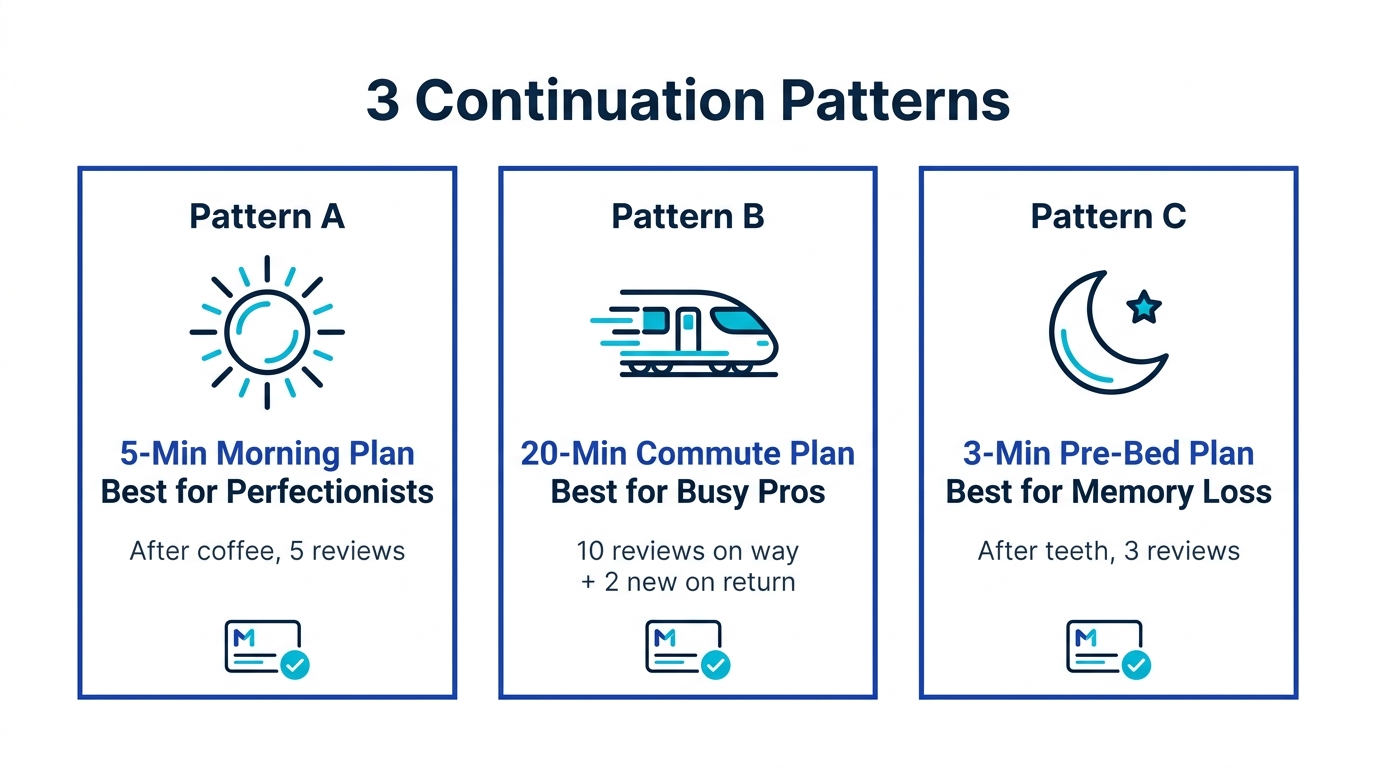
Pattern A: 5-Minute Morning Plan (Best for Perfectionists)
- 7am, immediately after pouring coffee, open Memly (Habit Stacking)
- Review exactly 5 cards, a slightly extended take on James Clear's 2-Minute Rule, which keeps any new habit small enough to finish in about two minutes
- Single goal: extend the streak. Nothing else matters.
- Do not create new cards. Reviews only.
Pattern B: 20-Minute Round-Trip Commute Plan (Best for Time-Constrained Professionals)
- The moment you sit on the train, Memly opens before social media does
- 10 reviews on the way to work, 2 new cards on the way home
- Hard stop 3 stations before your destination (boundary control)
- Zero study at home (friction cost minimization)
Pattern C: 3-Minute Pre-Bed Plan (Best for Memory-Leak Profile)
- Immediately after brushing teeth, open Memly (Habit Stacking)
- 3 review cards, then bed
- Maximizes overnight memory consolidation (Walker, 2017)
- Confirm retention in the next morning's review
For week 1, defend the minimum pace at all costs. The point is not to learn more. The point is to install the prediction "I can sustain this," because that prediction is what carries you through the first day you do not feel like studying. Once it is in place, scaling up gets much easier. For tool selection details, see best AI flashcard apps reviewed.
Frequently Asked Questions
Q1: How long does it actually take to form a habit?
Lally et al. (2010) studied real-world habit formation and found a median of 66 days, with a range of 18 to 254 days depending on complexity. The popular "21 days" claim has no empirical basis. Plan for 2 to 3 months minimum.
Q2: Can I study multiple subjects at once?
During the formation phase, focus on one subject and one pattern. Lally et al. (2010) found that simultaneous habit formation cut continuation rates roughly in half. Add the second subject only after the first has been automatic for 4+ weeks.
Q3: What if I miss a few days during a vacation or holiday?
Restart at 70 to 80% of the previous pace, not 100%. Trying to "make up" days is the single biggest cause of secondary collapse. Detailed protocols are in post-vacation study burnout recovery.
Q4: I work 60+ hours a week. I genuinely have no time.
Memly is engineered to fit inside commute and bathroom break gaps alone. The full case study is in study during your commute. The professionals who sustain study programs longest are not the ones with the most time. They are the ones who shrank the daily action the most.
Q5: How do I handle motivation drops?
Motivation oscillates by design. On low days, drop to absolute minimum (1 card). Do not skip. Clear (2018) found that the most successful long-term studiers also resist the temptation to over-study on high-motivation days — they hold pace stable, treating consistency, not output, as the asset.
Final Word: Sustained Studying Is an Engineered System, Not Willpower
Working professionals do not abandon studying because they are weak. They abandon it because perfectionism + ignored forgetting curves + dopamine dysregulation + collapsed self-efficacy + environmental friction + isolation + invisible progress = a system designed to fail. The ones who last have engineered around all 7 with the same 4 mechanisms: shrink the action, stack to existing habits, make progress visible, and pre-design recovery.
Most people who agree with all of this will start again in January, on the same terms that failed the last time. If you want to be in the minority who actually sustains: commit to one specific thing tonight. Tomorrow morning, immediately after a daily action you already do (brushing teeth, pouring coffee, sitting on the train), open Memly and answer exactly one card. Do not promise more. One card is the entire commitment. That single action begins a streak — and a streak is what tells your brain "I am the kind of person who sustains things." Self-efficacy gets rebuilt one card at a time. No payment method is required, and the free plan takes about 30 seconds to start.
For the foundational view of AI-assisted memorization, the pillar piece is what is AI-assisted memorization. If you are restarting after a holiday, the playbook is in post-vacation study burnout recovery. New to a job and overwhelmed by what you need to learn? Start with why you can't remember things at work.
