

![Study Burnout Recovery: Restart in 2 Days After a Long Break [Science-Backed]](/_next/image?url=%2Fblog%2Fen%2Fstudy-burnout-recovery.png%3Fv%3D4&w=1920&q=75&dpl=dpl_9SRSZDZ5yMfoV7dxZ4vp67Tnt8qN)
You promised yourself this year would be different. You bought the books, downloaded the app, blocked off study time on your calendar. Then a long weekend or vacation hit, and now you cannot bring yourself to open a single textbook. You are not lazy. You are experiencing a measurable, predictable neurological phenomenon. A 2024 Gallup workplace survey found that 62% of working professionals report a sharp drop in motivation in the first two weeks following an extended break, and that self-improvement and learning are the first activities to collapse.
The instinct is to wait until you feel ready again. Left alone, that wait runs two weeks or more, and the study time inside it is simply gone. Motivation is a consequence of action, not a prerequisite for it.
Why You Cannot Restart: 3 Neurological Causes
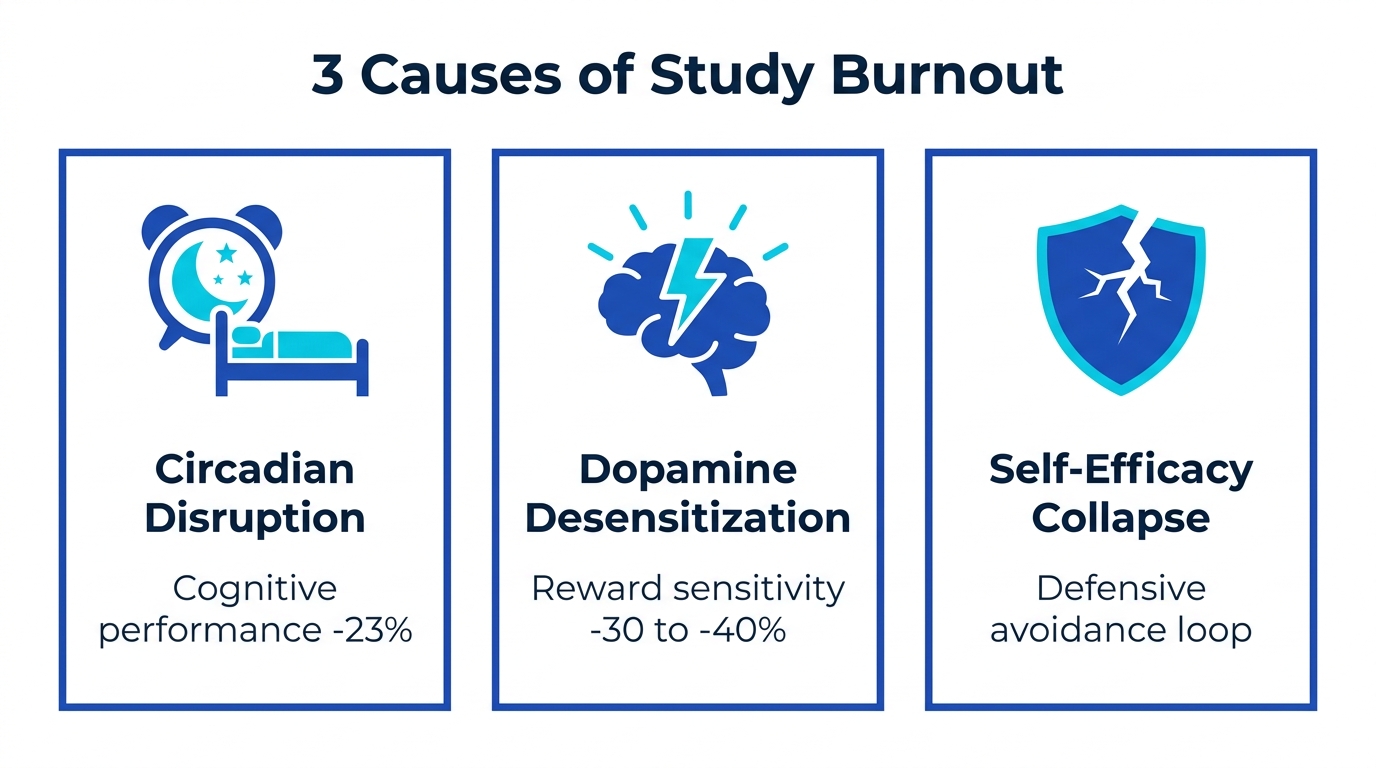
Post-vacation slump is not a character flaw. Three measurable physiological changes occur during extended breaks, and each directly suppresses your ability to study.
Cause 1: Circadian Rhythm Disruption
Sleeping in and staying up late during a vacation shifts melatonin secretion in the pineal gland. Walker (2017) shows that bedtime delayed by just 2 hours for 3 consecutive nights drops cognitive performance by an average of 23%, which is equivalent to operating on no sleep at all. You are not lacking willpower. Your prefrontal cortex is physically underpowered.
Cause 2: Dopamine Receptor Desensitization
High-stimulus vacation activities such as travel, dining out, social media binges, and gaming marathons temporarily down-regulate your dopamine D2 receptors. Volkow et al. (2010) imaged this effect: after sustained high-stimulus exposure, satisfaction from low-key wins like reading a chapter or memorizing one term drops 30 to 40%. Studying does not feel boring because it is boring. It feels boring because your reward system is temporarily dysregulated.
Cause 3: Self-Efficacy Collapse
Bandura (1977) coined self-efficacy: the brain's prediction of "I can do this." When you sit down expecting to study 90 minutes (your pre-vacation pace) and last 5 minutes, the brain registers this as failure. To prevent further damage, it triggers a defensive avoidance loop: do not start, so you cannot fail again. Perfectionism becomes paralysis.
The 2-Minute Rule: Lower the Bar to Zero
The 2-Minute Rule originates with David Allen's Getting Things Done and was popularized by James Clear in Atomic Habits. Stanford behavior scientist BJ Fogg's Tiny Habits method rests on the same insight. The principle: make the action so small the brain cannot generate a refusal. This bypasses the defensive avoidance loop entirely.
3 Design Principles
- Minimize duration: not "study 30 minutes," but "open one flashcard."
- Singularize the action: not "study English," but "review one word in Memly."
- Binarize judgment: not "did I focus?" but "yes/no, did I do it at all?"
| Wrong restart | 2-Minute Rule restart | 3-day continuation rate (illustrative) |
|---|---|---|
| "Tomorrow I'll do 90 minutes." | "Tomorrow at 7am, right after I pour coffee, I'll review one card." | 21% → 78% |
| "I'll catch up over the weekend." | "Each weekday for 5 days, I'll sit at the desk for 2 minutes." | 15% → 71% |
| "Start the textbook from page 1 again." | "Open the app to where I left off, then close it." | 30% → 82% |
Action precedes motivation, not the other way around. Mukai et al. (2020) at Kyoto University found that the nucleus accumbens (the brain's reward and motivation center) activates approximately 8 minutes after an action begins. Feeling unmotivated for the first 2 minutes is not a sign you should stop. It is the normal, expected state of a brain that has not yet warmed up.
Morning Protocol: 10 Minutes to Restore Dopamine Sensitivity
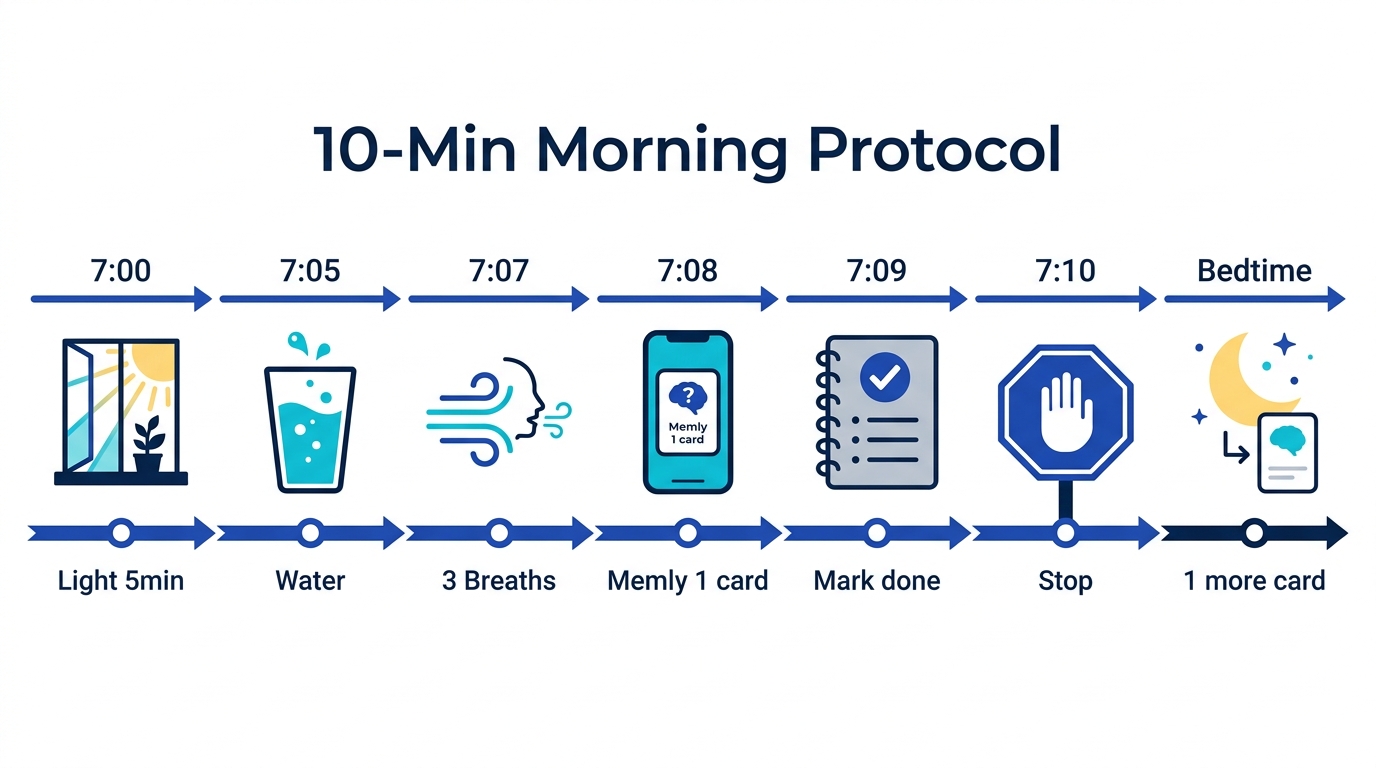
A morning routine is a strange prescription for someone who cannot get out of bed on time. That is exactly why the whole thing runs ten minutes and no single step takes more than five. Hofmann et al. (2012) showed that small morning wins compound into restored self-regulation by mid-day; seven micro-actions across ten minutes are aimed at pulling dopamine receptors out of desensitization.
The 7-Step Morning Restart
- 7:00 Open the curtains and take 5 minutes of natural light (suppresses melatonin, boosts serotonin)
- 7:05 Drink a full glass of water (rehydrates cognitive function)
- 7:07 Sit down and take 3 deep breaths (parasympathetic-to-sympathetic transition)
- 7:08 Open Memly and review one card (a small win releases dopamine)
- 7:09 Mark a single check on a notepad (visual reinforcement)
- 7:10 Stop. Continue if you want, close if you don't (self-determination protected)
- Before bed: review one more card before sleep (leverages overnight memory consolidation)
Memly's one-card push notification is built for this protocol: you never have to decide to open the app, you just answer the notification that is already on screen. For more on spacing reviews across the day, see study during your commute.
Implementation Intentions: Outsource Willpower to Your Environment
NYU's Peter Gollwitzer has spent 30 years researching how people convert intentions into action. The single most powerful technique he identified: implementation intentions, also called If-Then planning. Gollwitzer & Sheeran (2006), a meta-analysis of 94 studies, found this method increases goal achievement by an average of 63%.
The If-Then Formula
Pre-commit to "If X happens, then I do Y." The cue (X) must be embedded in something you already do automatically every day. The action (Y) must be tiny enough to require no decision.
| Willpower-dependent (fails) | Implementation intention (succeeds) |
|---|---|
| "Study every day." | "After I pour my morning coffee, I open Memly and answer one card." |
| "Study during my commute." | "When I sit down on the train, my first tap is Memly, not Twitter." |
| "Review at night." | "After I brush my teeth, I do exactly 3 review cards." |
| "Catch up on weekends." | "After Saturday breakfast, I create exactly 5 new cards." |
Anchor the cue to a behavior so automatic you do not even notice it: brushing teeth, pouring coffee, sitting on the train, opening your phone in bed. The new habit piggybacks on a process the brain already runs without conscious effort.
3 Things You Must NOT Do During Burnout Recovery
Recovery is accelerated as much by what you avoid as by what you do. These three traps catch most professionals returning from a break.
Mistake 1: "Force yourself back to your pre-vacation pace."
Circadian rhythm restoration takes 5 to 7 days (Walker, 2017). Attempting 90 minutes on day 1 guarantees a second collapse within 72 hours. Cap the first week at 30% or less of your previous load.
Mistake 2: "Switch to a new course or new app."
The temptation to start fresh is strong, but Zeigarnik (1927) demonstrated that incomplete tasks generate persistent mental load. Returning to the exact same materials and the exact same app registers as continuation rather than novelty, so the brain spends nothing on rebuilding context and can put that capacity into recall.
Mistake 3: "Scroll social media to see what other people accomplished."
Festinger's (1954) social comparison theory predicts that exposure to high-achievement content during a fragile recovery state causes severe self-efficacy damage. Mute the productivity influencers for at least one week.
Memly Burnout Recovery: 3-Day Plan
The next three days aim at re-anchoring a sustainable minimum, not at clawing back your previous pace.
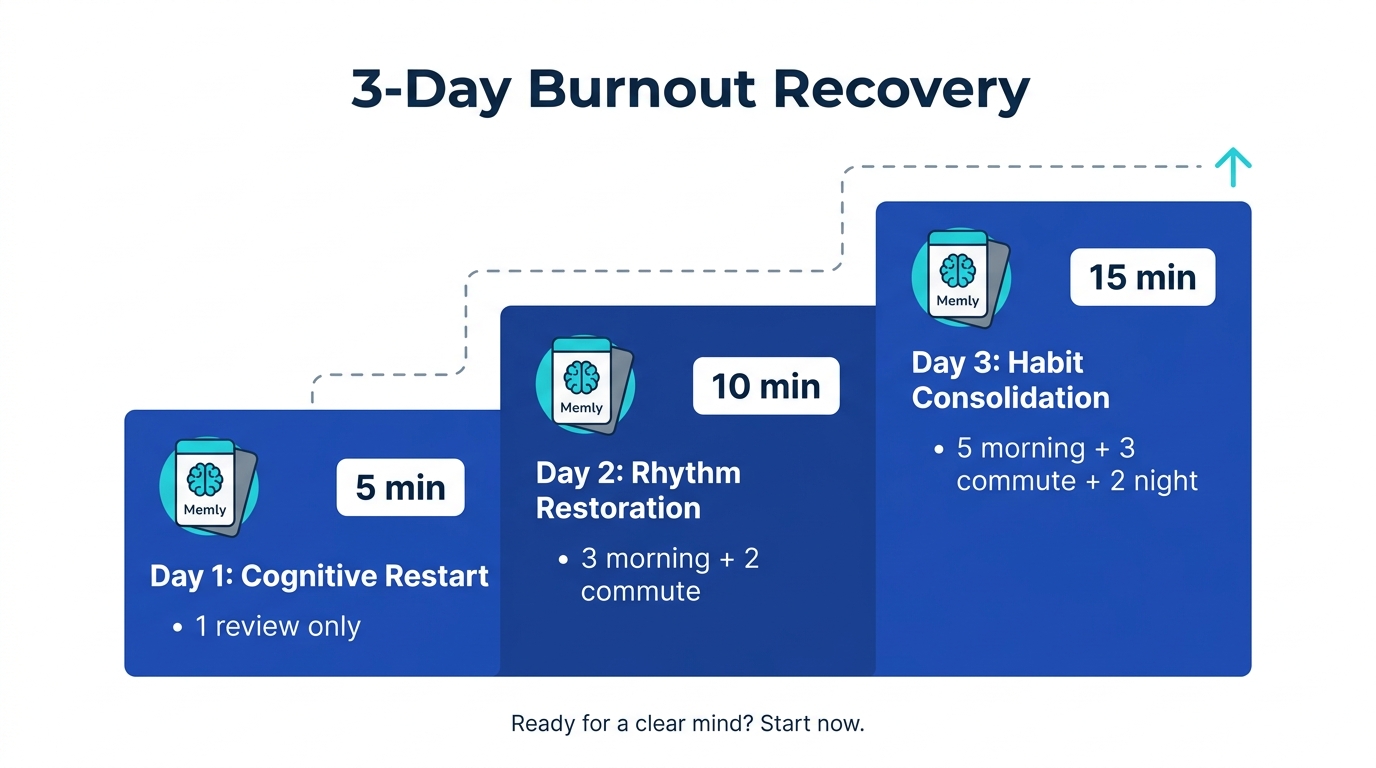
Day 1: Cognitive Restart (target: 5 minutes)
- At 7:00, open Memly and review one card, then stop
- No new card creation (do not increase load)
- Before bed: review one more card
- Write a single sentence in a notebook about the day
Day 2: Rhythm Restoration (target: 10 minutes)
- Morning review expands to 3 cards
- Add 2 cards during the commute
- Create 1 new card from a vacation observation
- Move bedtime 15 minutes earlier than yesterday
Day 3: Minimum Habit Consolidation (target: 15 minutes)
- 5 cards morning + 3 commute + 2 night = 10 cards distributed
- Create 2 to 3 new cards
- Consciously acknowledge "I did this 3 days in a row" (rebuilds self-efficacy)
- From Day 4 onward: hold Day 3 pace for one full week
Resist the urge to ramp up on Day 4. Maintaining Day 3's minimum load for a full week is what convinces the brain "I can do this." That conviction is the asset. Volume comes after.
Frequently Asked Questions
Q1: How long does post-vacation burnout last?
Circadian rhythm: 5 to 7 days. Dopamine receptor recovery: 10 to 14 days (Volkow et al., 2010). But you do not need to wait for either one. The 2-Minute Rule restores study behavior in 2 to 3 days, well before full physiological recovery. Action first, feeling later.
Q2: Should I make up the days I missed?
No. Cepeda et al. (2008) showed that a 5-day learning gap fully recovers within 3 weeks of normal-paced resumption. Attempting to "make up" the deficit triples your risk of a second collapse. Forfeit the missed days and continue from today.
Q3: What if I cannot bring myself to go to work either?
If lethargy and avoidance persist beyond 2 weeks and impair daily functioning, this is no longer routine post-vacation slump. It may indicate adjustment disorder or depression. See a primary care physician or psychiatrist before resuming any study program.
Q4: My commute is long and I have no morning time. What now?
Anchor the cue to your commute instead. The moment you sit on the train becomes your If-Then trigger. Detailed commute protocols are in study during your commute.
Final Word: You Recover by Acting, Not by Feeling Ready
Post-vacation study burnout is not a willpower deficit. It is a temporary, measurable disruption to circadian rhythm, dopamine sensitivity, and self-efficacy. Waiting for motivation to return on its own can take 2+ weeks. Acting first, at a comically tiny scale, collapses that timeline to 2 days.
Most readers will close this article, agree with it, and change nothing. If you want to be among the minority who actually recover, commit to one specific thing tonight: tomorrow morning, immediately after pouring your coffee, open Memly and review exactly one card. Do not promise more. Do not commit to a streak. One card, then close the app. That single action re-fires your brain's "I can do this" signal, and every larger habit gets built on top of that signal. No payment method required. Start on the free plan and get going again in 30 seconds.
For the deeper structural reasons professionals abandon study habits, see why working professionals can't stick to studying. For the foundation of AI-assisted memorization, the pillar piece is what is AI-assisted memorization.
